Fishman comments: The effect of Botox on ocular surface disease is seriously under appreciated. While the cosmetic benefit of Botox is widely known, Botox use was actually “invented” by an Ophthalmologist (Dr. Alan Scott) to treat strabismus (eye muscle misalignment) in kids.
BoTox does have some other less well known off-label uses including reducing eyelid friction in cases of SLK (Botox the muscle of Riolan), reducing epiphora in cases of obstructive outflow (both functional and mechanical), and pain control in neuropathic pain syndrome. These are just a few examples, but this paper provides a nice summary of other effects on the ocular surface.
Ren-Wen Ho et al. Toxins 2019, 11, 66; doi:10.3390/toxins11020066
Abstract
Clinical usage of botulinum neurotoxin (BoNT) in ophthalmology has dramatically increased since the 1980s and has become one of the most widely used agents for treating facial movement disorders, autonomic dysfunction and aesthetic wrinkles. Despite its high efficacy, there are some complications with periocular BoNT injections due to its chemodenervation effect. Among these, there is still controversy over the BoNT effect on tear film homeostasis and the ocular surface. A periocular BoNT injection could dry the eye by reducing tear production of the lacrimal gland and increase tear evaporation due to potential eyelid malposition and abnormal blinks. On the contrary, the injection of BoNT in the medial eyelids could treat dry eye disease by impairing lacrimal drainage. Regarding the ocular surface change, corneal astigmatism and high-order aberrations may decrease due to less eyelid tension. In conclusion, the entire awareness of the effect of BoNT and the patients’ ocular condition is crucial for successful and safe results.
A few comments on mechanism (if you are interested..)
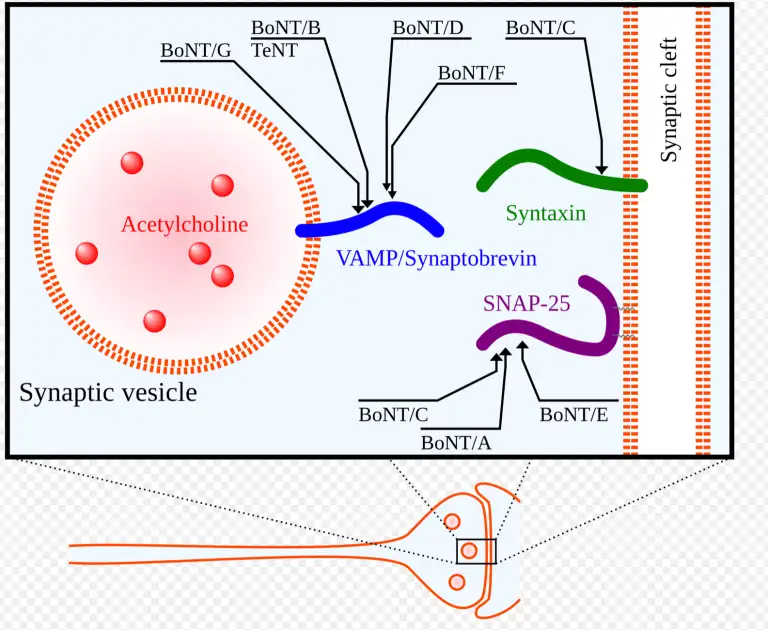
The below figure (from Emerg Infect Dis. 2005;11(10):1578-1583) nicely illustrates the mechanism of how BoTox inhibits vesicular docking at the pre-synaptic neuron. “BoNTs are zinc metalloproteases that cleave and inactivate specific cellular proteins essential for the release of the neurotransmitter acetylcholine.” More specifically, Botox cleaves SNARE proteins (https://doi.org/10.1016/S0092-8674(00)80727-8) and SNARE proteins mediate vesicle fusion. As an aside, I did my PhD in Prof. Richard Scheller’s lab (and ZareLab) at Stanford where many of these mechanisms of synaptic neurotransmission were discovered.
Above figure from the paper – Barr JR, Moura H, Boyer AE, Woolfitt AR, Kalb SR, Pavlopoulos A, et al. Botulinum Neurotoxin Detection and Differentiation by Mass Spectrometry. Emerg Infect Dis. 2005;11(10):1578-1583. https://dx.doi.org/10.3201/eid1110.041279