Purpose: To investigate the composition and diversity of bacterial community on the ocular surface of patients with meibomian gland dysfunction (MGD) via 16S rDNA sequencing.
Methods: Forty-seven patients with MGD, who were divided into groups of mild, moderate, and severe MGD, and 42 sex- and age-matched participants without MGD (control group) were enrolled. Samples were collected from the upper and lower conjunctival sac of one randomly chosen eye of each participant. Through sequencing the hypervariable region of 16S rDNA gene obtained from samples, differences in the taxonomy and diversity between groups were compared.
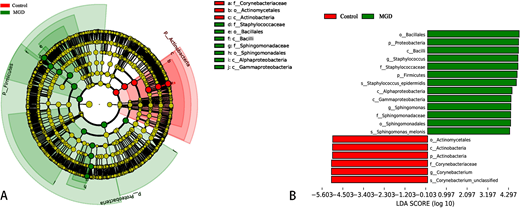
Results: Principle coordinate analysis showed significantly distinct clustering of the conjunctival sac bacterial community between the severe MGD group and the other groups. At the phylum level, the relative abundances of Firmicutes (31.70% vs. 19.67%) and Proteobacteria (27.46% vs. 14.66%) were significantly higher (P < 0.05, Mann-Whitney U), and the abundance of Actinobacteria (34.17% vs. 56.98%) was lower in MGD than controls (P < 0.05, Mann-Whitney U). At the genus level, the abundances of Staphylococcus (20.71% vs. 7.88%) and Sphingomonas (5.73% vs. 0.79%) in patients with MGD were significantly higher than the controls (P < 0.05, Mann-Whitney U), while the abundance of Corynebacterium (20.22% vs. 46.43%) was significantly lower (P < 0.05, Mann-Whitney U). The abundance of Staphylococcus was positively correlated with the meiboscores in patients with MGD (r = 0.650, P < 0.001, Spearman).
Conclusions: Patients with MGD can have various degrees of bacterial microbiota imbalance in the conjunctival sac. Staphylococcus, Corynebacterium, and Sphingomonas may play roles in the pathophysiology of MGD.