Dr. Fishman’s commentary: Potentially a very powerful steroid sparring way to treat oral Lichen Planus. It would be interesting if we could perform a clinical trial involving high dose curcuminoids for treating Lichen Planus of the conjunctiva. Lichen planus is an autoimmune condition of unknown aetiology affecting the skin and mucous membranes. Conjunctival lichen planus can lead to irreversible damage to the ocular surface and loss of vision from corneal scarring.
Authors: Chainani-Wu, Nita et al. Journal of the American Academy of Dermatology, Volume 66, Issue 5, 752 – 760 (DOI: https://doi.org/10.1016/j.jaad.2011.04.022)
Background
Curcuminoids are components of turmeric (Curcuma longa) that possess anti-inflammatory properties.
Objective
We sought to study the efficacy of curcuminoids in controlling the signs and symptoms of oral lichen planus, at doses of 6000 mg/d (3 divided doses), and their safety at this dose.
Methods
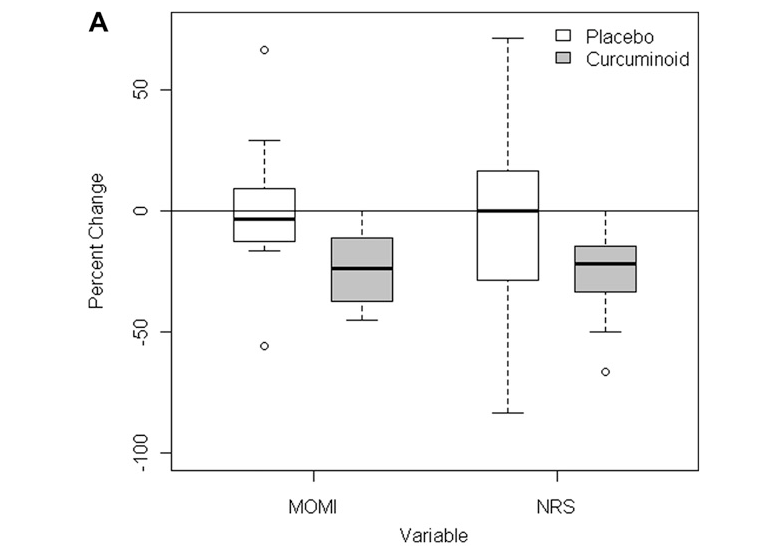
Twenty consecutive, eligible patients who consented were enrolled into this randomized, double-blind, placebo-controlled clinical trial in 2007 through 2008. Measurement of symptoms and signs of oral lichen planus using the Numerical Rating Scale (NRS) and the Modified Oral Mucositis Index (MOMI), respectively; complete blood counts; liver enzymes; C-reactive protein; and interleukin-6 levels was done at baseline and day 14. Two-sided P values are reported.
Results
In the placebo group, the percentage changes from baseline in NRS (median [interquartile range] = 0.00 [−29 to 16.7], P > .99), erythema (0.00 [−10 to 16.7], P = .98), ulceration (0.00 [0.00 to 26.7], P = .63), and total MOMI scores (−3.2 [−13 to 9.09], P = .95) were not statistically significant, whereas they were statistically significant in the curcuminoids group: NRS (−22 [−33 to −14], P = .0078); erythema (−17 [−29 to −8.3], P = .0078), ulceration (−14 [−60 to 0.00], P = .063), MOMI (−24 [−38 to −11], P = .0039). The curcuminoids group showed a greater reduction in clinical signs and symptoms as compared with the placebo group, measured by percentage change in erythema (P = .05) and total MOMI score (P = .03), and proportion showing improvement in NRS (0.8 vs 0.3, P = .02) and total MOMI score (0.9 vs 0.5, P = .05). Adverse effects were uncommon in both groups.
Limitations
The small sample size resulted in limited power, particularly for multivariate analyses.
Conclusions
Curcuminoids at doses of 6000 mg/d in 3 divided doses are well tolerated and may prove efficacious in controlling signs and symptoms of oral lichen planus.