Effect of IRT5 probiotics on dry eye in the experimental dry eye mouse model
Jayoon Moon, Jin Suk Ryu, Jun Yeop Kim, Sin-Hyeog Im, Mee Kum Kim
Abstract
Objective
To investigate the clinical effects of IRT5 probiotics in the environmental dry eye model.
Methods
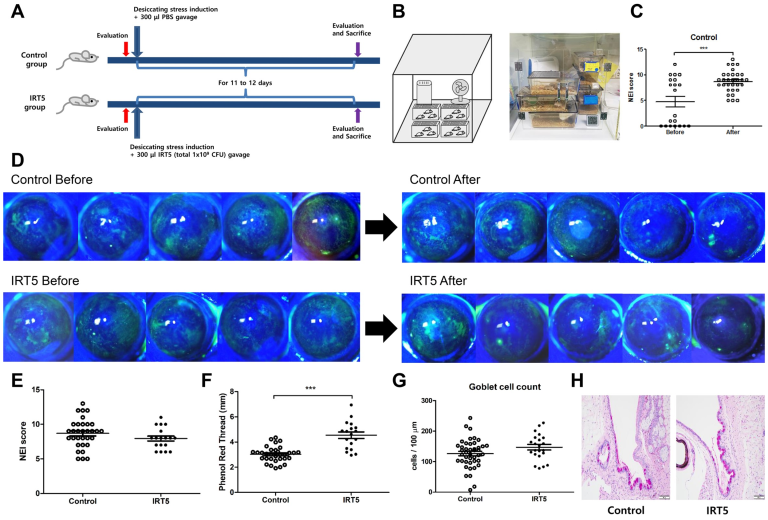
Eight week old male C57BL/6 mice were randomly divided into two groups; control group (n = 16) received oral gavage of 300 μL phosphate-buffered saline (PBS) alone once daily, IRT5 group (n = 9) received oral gavage of 1 x 10⁹ CFU IRT5 probiotics powder in 300 μL PBS once daily, both groups for 11 to 12 days. Simultaneously, all mice underwent dry eye induction. Tear secretion, corneal staining and conjunctival goblet cell density were evaluated. Quantative real-time polymerase chain reaction (RT-PCR) for inflammation-related markers was performed. 16S ribosomal RNA of fecal microbiome was analyzed and compositional difference, alpha and beta diversities were assessed.
Results
There was no difference in NEI score but significant increase in tear secretion was observed in IRT5 group (p < 0.001). There was no significant difference in goblet cell density between groups. Quantative RT-PCR of cornea and conjunctiva revealed increased TNF-α expression in IRT5 group (p < 0.001) whereas other markers did not significantly differ from control. IRT5 group had significantly increased species diversity by Shannon index (p = 0.041). Beta diversity of genus by UniFrac principle coordinates analysis showed significant distance between groups (p = 0.001). Compositional differences between groups were observed and some were significantly associated with tear secretion. Multivariate linear regression analysis revealed Christensenellaceae (p = 0.009), Lactobacillus Helveticus group (p = 0.002) and PAC001797_s (p = 0.011) to strongly influence tear secretion.
Conclusion
In experimental dry eye model, IRT5 probiotics treatment partially improves experimental dry eye by increasing tear secretion which was associated with and influenced by the change in intestinal microbiome. Also, intestinal microbiome may affect the lacrimal gland through a different mechanism other than regulating inflammation.
Citation: Moon J, Ryu JS, Kim JY, Im S-H, Kim MK (2020) Effect of IRT5 probiotics on dry eye in the experimental dry eye mouse model. PLoS ONE 15(12): e0243176. doi:10.1371/journal.pone.0243176
— Read on journals.plos.org/plosone/article